Paris is the capital city of France. It is situated on the River Seine, in northern France, at the heart of the Île-de-France region ("Région parisienne"). The City of Paris has an estimated population of 2,153,600 within its administrative limits. The Paris unité urbaine (or urban area) is an area of unbroken urban growth that extends well beyond the administrative city limits and has a population of 9.93 million. A commuter belt around the unité urbaine completes the Paris aire urbaine (or metropolitan area) that, with its population of 12 million, is one of the most heavily populated areas in Europe.
An important settlement for more than two millennia, Paris is today one of the world's leading business and cultural centres, and its influence in politics, education, entertainment, media, fashion, science and the arts all contribute to its status as one of the world's major global cities. The Paris Region (Île-de-France) is France's foremost centre of economic activity. With €500.8 billion (US$628.9 billion), it produced more than a quarter of the gross domestic product (GDP) of France in 2006. The Paris Region hosts 36 of the Fortune Global 500 companies in several business districts, notably La Défense, the largest purpose-built business district in Europe. Paris also hosts many international organizations such as UNESCO, the OECD, the ICC and the informal Paris Club.
Paris is the most popular tourist destination in the world, with over 30 million foreign visitors per year. There are numerous iconic landmarks among its many attractions, along with world famous institutions and popular parks.
Thursday, November 29, 2007

Wednesday, November 28, 2007
Amsterdam --- Netherlands

Amsterdam is the capital of the Netherlands. The city is known for its historic port, the Rijksmuseum, the red-light district (de Wallen), the liberal coffeeshops, and the canals which have led to Amsterdam being termed the "Venice of the North". During the Dutch Golden Age, Amsterdam was one of the most important ports in the world, with innovative developments in trade, and became the leading centre for finance and diamonds.
The city was founded in the late 12th century as a small fishing village, and has grown to become the largest city in the Netherlands with a population of 743,027 inhabitants, which includes 177 different nationalities, making Amsterdam the most multicultural city in the world.
The metropolitan region has a population of 1,021,870 inhabitants and is part of the conglomerate metropolitan area Randstad, with a population of 6,659,300 inhabitants. The name Amsterdam is a derivative from Amstel dam, that is, a dam in the river Amstel.
The city was founded in the late 12th century as a small fishing village, and has grown to become the largest city in the Netherlands with a population of 743,027 inhabitants, which includes 177 different nationalities, making Amsterdam the most multicultural city in the world.
The metropolitan region has a population of 1,021,870 inhabitants and is part of the conglomerate metropolitan area Randstad, with a population of 6,659,300 inhabitants. The name Amsterdam is a derivative from Amstel dam, that is, a dam in the river Amstel.
Hamburg --- Germany

Hamburg (German language pronunciation: [hamburg]; Low German: Hamborg, ['hamburg]) is the second largest city in Germany and along with Hamburg Harbour, its principal port, Hamburg is also the second largest port city in Europe, ninth largest port in the world, and the largest city in the European Union which is not a national capital.
The official name Free and Hanseatic City of Hamburg (German: Freie und Hansestadt Hamburg; Low German: Free un Hansestadt Hamborg) refers to Hamburg's membership in the medieval Hanseatic League and the fact that Hamburg is a City State and one of the sixteen Federal States of Germany.
Hamburg is on the southern tip of the Jutland Peninsula, centered between Continental Europe to the south, Scandinavia to the north, the North Sea to the west, and the Baltic Sea to the east. The city of Hamburg lies at the junction of the River Elbe with the rivers Alster and Bille. The city center is set around two lakes, the Binnenalster ("Inner Alster") and the Außenalster("Outer Alster").
An international trade city, Hamburg is the commercial and cultural centre of Northern Germany. Its citizens are known as Hamburger.
The official name Free and Hanseatic City of Hamburg (German: Freie und Hansestadt Hamburg; Low German: Free un Hansestadt Hamborg) refers to Hamburg's membership in the medieval Hanseatic League and the fact that Hamburg is a City State and one of the sixteen Federal States of Germany.
Hamburg is on the southern tip of the Jutland Peninsula, centered between Continental Europe to the south, Scandinavia to the north, the North Sea to the west, and the Baltic Sea to the east. The city of Hamburg lies at the junction of the River Elbe with the rivers Alster and Bille. The city center is set around two lakes, the Binnenalster ("Inner Alster") and the Außenalster("Outer Alster").
An international trade city, Hamburg is the commercial and cultural centre of Northern Germany. Its citizens are known as Hamburger.
Graz --- Austria
Graz [graːts] (etymologically from Slovenian: Gradec IPA: /gra.deʦ/, "little castle"), with a population of 287,723 as of 2006 (of which 250,099 have principal residence status), is the second-largest city in Austria after Vienna and the capital of the federal state of Styria(Steiermark in German).
Graz has a long tradition as a student city: its six universities have over 40,000 students. Graz's "Old Town" is one of the best-preserved city centers in Central Europe. In 1999, it was added to the UNESCO list of World Cultural Heritage Sites. Graz was sole Cultural Capital of Europe for 2003.
Graz has a long tradition as a student city: its six universities have over 40,000 students. Graz's "Old Town" is one of the best-preserved city centers in Central Europe. In 1999, it was added to the UNESCO list of World Cultural Heritage Sites. Graz was sole Cultural Capital of Europe for 2003.
Frankfurt --- Germany
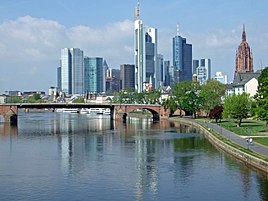
Frankfurt am Main (German: [frankfurt], English: [frankfurt] American English: [frankfurt]) is the largest city in the German state of Hesse and the fifth-largest city in Germany, with a mid-2007 population of 663,567. The urban area had an estimated population of 2,26 million in 2001. The city is at the center of the larger Frankfurt Rhine Main Area which has a population of 5,3 million and is Germany's second largest metropolitan area.
Situated on the Main River, Frankfurt is the financial and transportation centre of Germany and one of the two largest financial centres in continental Europe, the other one being Paris. It is the place of residence of the European Central Bank, the German Federal Bank, the Frankfurt Stock Exchange and the Frankfurt Trade Fair. Frankfurt International Airport is one of the world's busiest airports, Frankfurt Central Station is one of the largest terminal stations in Europe and the Frankfurter Kreuz (Autobahn interchange) is the most heavily used interchange in Europe. Frankfurt is the only german city listed as one of ten Alpha world cities.
Among English speakers the city is commonly known simply as "Frankfurt", though Germans occasionally call it by its full name when it is necessary to distinguish it from the other (significantly smaller) Frankfurt in the German state of Brandenburg, known as Frankfurt (Oder). It was once called Frankfort-on-the-Main in English, a translation of Frankfurt am Main. It is sometimes called FFM or Ffm, which is short for Frankfurt am Main. On road signs its mostly shortened as "F", for example "F-Sachsenhausen".
Frankfurt is sometimes nicknamed "Bankfurt", "Mainhattan" (a word-play with the local Main River and Manhatten) or "The Big Äppel" (also a reference to New York City and the local "Äppelwoi", or apple wine, a type of cider which is produced and drunk mainly in the region).
Situated on the Main River, Frankfurt is the financial and transportation centre of Germany and one of the two largest financial centres in continental Europe, the other one being Paris. It is the place of residence of the European Central Bank, the German Federal Bank, the Frankfurt Stock Exchange and the Frankfurt Trade Fair. Frankfurt International Airport is one of the world's busiest airports, Frankfurt Central Station is one of the largest terminal stations in Europe and the Frankfurter Kreuz (Autobahn interchange) is the most heavily used interchange in Europe. Frankfurt is the only german city listed as one of ten Alpha world cities.
Among English speakers the city is commonly known simply as "Frankfurt", though Germans occasionally call it by its full name when it is necessary to distinguish it from the other (significantly smaller) Frankfurt in the German state of Brandenburg, known as Frankfurt (Oder). It was once called Frankfort-on-the-Main in English, a translation of Frankfurt am Main. It is sometimes called FFM or Ffm, which is short for Frankfurt am Main. On road signs its mostly shortened as "F", for example "F-Sachsenhausen".
Frankfurt is sometimes nicknamed "Bankfurt", "Mainhattan" (a word-play with the local Main River and Manhatten) or "The Big Äppel" (also a reference to New York City and the local "Äppelwoi", or apple wine, a type of cider which is produced and drunk mainly in the region).
New York City --- America

New York City (officially The City of New York) is the largest city in the state of New York and the largest city in the United States. The center of the New York metropolitan area, it ranks among the largest urban areas in the world. For more than a century, it has been one of the world's major centers of commerce and finance. New York City is rated as an alpha world city for its global influences in media, politics, education, entertainment and fashion. The city's cultural centers for arts are among the nation's most influential. The city is a major center for foreign affairs, hosting the headquarters of the United Nations. Residents of the city are known as New Yorkers. The current mayor of New York City is Michael Bloomberg.
New York City comprises five boroughs, each of which is coterminous with a county: The Bronx, Brooklyn, Manhattan, Queens and Staten Island. With over 8.2 million residents within an area of 322 square miles (830 km²), New York City is the second most densely populated city in the United States, behind Union City, New Jersey, located across the Hudson River.
The city has many neighborhoods and landmarks known around the world. The Statue of Liberty greeted millions of immigrants as they came to America in the late 19th and early 20th centuries, at Ellis Island. Wall Street, in Lower Manhattan, has been a dominant global financial center since World War II and is home to the New York Stock Exchange. The city has been home to several of the tallest buildings in the world, including the Empire State Building and the former twin towers of the World Trade Center, which were destroyed in the September 11, 2001 attacks.
The city is the birthplace of many American cultural movements, including the Harlem Renaissance in literature and visual art, abstract expressionism (also known as the New York School) in painting, and hip hop, punk, salsa, and Tin Pan Alley in music. In 2005, nearly 170 languages were spoken in the city and 36 percent of its population was born outside the United States. With its 24-hour subway and constant bustling of traffic and people, New York is known as "The City That Never Sleeps."
New York City comprises five boroughs, each of which is coterminous with a county: The Bronx, Brooklyn, Manhattan, Queens and Staten Island. With over 8.2 million residents within an area of 322 square miles (830 km²), New York City is the second most densely populated city in the United States, behind Union City, New Jersey, located across the Hudson River.
The city has many neighborhoods and landmarks known around the world. The Statue of Liberty greeted millions of immigrants as they came to America in the late 19th and early 20th centuries, at Ellis Island. Wall Street, in Lower Manhattan, has been a dominant global financial center since World War II and is home to the New York Stock Exchange. The city has been home to several of the tallest buildings in the world, including the Empire State Building and the former twin towers of the World Trade Center, which were destroyed in the September 11, 2001 attacks.
The city is the birthplace of many American cultural movements, including the Harlem Renaissance in literature and visual art, abstract expressionism (also known as the New York School) in painting, and hip hop, punk, salsa, and Tin Pan Alley in music. In 2005, nearly 170 languages were spoken in the city and 36 percent of its population was born outside the United States. With its 24-hour subway and constant bustling of traffic and people, New York is known as "The City That Never Sleeps."
Bursa --- Turkey

Bursa (historically also known as Brusa, Greek: Προύσσα, Prusa) is a city in northwestern Turkey and the seat of Bursa Province. With a population of 1,194,687 (2000 census), it is Turkey's fourth largest city, as well as one of the most industrialized and culturally charged metropolitan centers in the country.
The city is frequently cited as "Yeşil Bursa" (meaning "Green Bursa") in a reference to the beautiful parks and gardens located across its urban tissue, as well as to the vast forests in rich variety that extend in its surrounding region. The city is synonymous with the mountain Uludağ which towers behind the city core and which is also a famous ski resort. The mausoleums of early Ottoman sultans are located in Bursa and the numerous edifices built throughout the Ottoman period constitute the city's main landmarks. The surrounding fertile plain, its thermal baths, several interesting museums, notably a rich museum of archaeology, and a rather orderly urban growth are further principal elements that complete Bursa's overall picture.
Karagöz and Hacivat shadow play characters were historic personalities who lived and who are buried in Bursa. Bursa is also home to some of the most famous Turkish dishes, especially candied chestnuts and İskender kebap. Its peaches are also well-renowned. Among its depending district centers, İznik, historic Nicaea, is especially notable for its long history and important edifices. Bursa is home to Uludağ University, and its population attains one of the highest overall levels of education in Turkey. It has traditionally been a pole of attraction and of refuge for immigration into Turkey from the Balkans, in sizable waves at times until quite recently.
The city is frequently cited as "Yeşil Bursa" (meaning "Green Bursa") in a reference to the beautiful parks and gardens located across its urban tissue, as well as to the vast forests in rich variety that extend in its surrounding region. The city is synonymous with the mountain Uludağ which towers behind the city core and which is also a famous ski resort. The mausoleums of early Ottoman sultans are located in Bursa and the numerous edifices built throughout the Ottoman period constitute the city's main landmarks. The surrounding fertile plain, its thermal baths, several interesting museums, notably a rich museum of archaeology, and a rather orderly urban growth are further principal elements that complete Bursa's overall picture.
Karagöz and Hacivat shadow play characters were historic personalities who lived and who are buried in Bursa. Bursa is also home to some of the most famous Turkish dishes, especially candied chestnuts and İskender kebap. Its peaches are also well-renowned. Among its depending district centers, İznik, historic Nicaea, is especially notable for its long history and important edifices. Bursa is home to Uludağ University, and its population attains one of the highest overall levels of education in Turkey. It has traditionally been a pole of attraction and of refuge for immigration into Turkey from the Balkans, in sizable waves at times until quite recently.
Subscribe to:
Posts (Atom)